Climate Risks – Cost or Opportunity?
24 September 2025
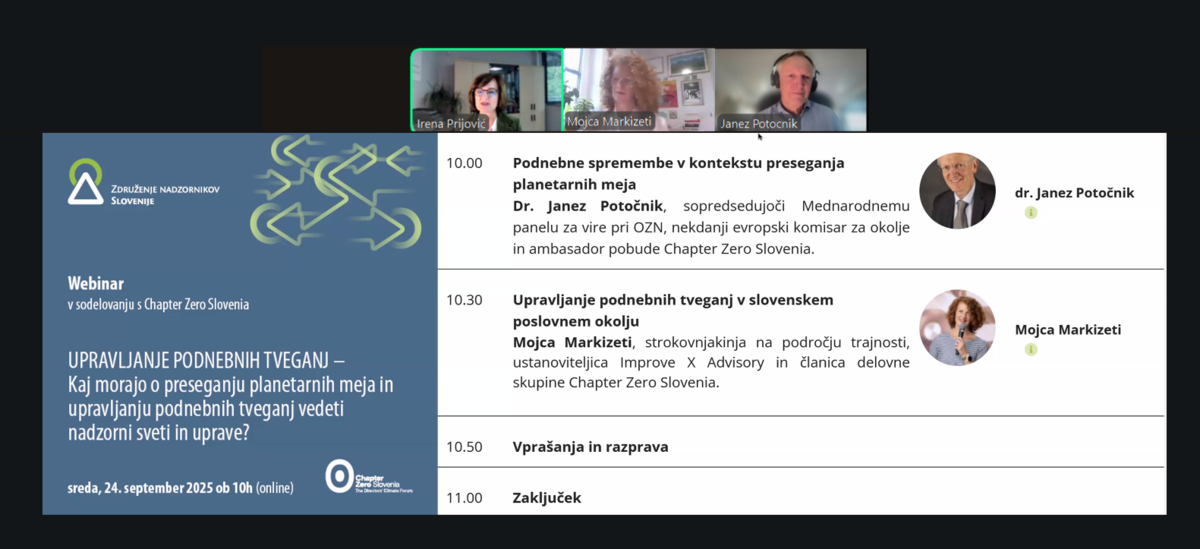
In cooperation with the Slovenian Directors’ Association, we organised a webinar on 24 September 2025 for board directors to discuss how crossing planetary boundaries and climate change affect the future of business.
Crossing Planetary Boundaries – A Moral and Strategic Challenge
Dr Janez Potočnik, Co-Chair of the UN International Resource Panel, former European Commissioner for the Environment, and Ambassador of Chapter Zero Slovenia, warned that humanity is already exceeding six of the nine planetary boundaries. “We are indebting future generations not only financially but also through the destruction of nature,” he stressed.
Managing natural resources is crucial for the prosperity of nations, yet throughout history it has often been a source of conflict. Since 1970, raw material consumption has more than tripled, particularly in the field of non-metallic materials for urbanisation and infrastructure. The most developed economies are the most resource-intensive – they demand more resources and create the largest environmental footprint.
Potočnik highlighted that we must urgently decouple economic growth from resource use and environmental impacts. A sustainable future can be shaped through the circular economy, which makes it possible to meet human needs with the least possible use of energy and materials. To make this transition truly feasible, three changes are essential: 1) clear orientation with measurable targets on the use of resources, 2) improved measurement and monitoring, and 3) reshaping the signals that markets and legislation send to companies and consumers – so that economic success based on the circular economy becomes more attractive than success still dependent on resource exploitation.
Climate Risks – Cost or Opportunity
Mojca Markizeti, sustainability expert and founder of Improve X Advisory, placed the discussion in the context of the Slovenian economy. She pointed out that Slovenia has warmed above the global average, which is already affecting the frequency of droughts, heat waves, and floods. The floods of 2023 caused economic damage equivalent to around 16% of GDP.
Businesses experience climate risks on three key levels:
- financial pressures, as banks and investors increasingly link access to capital to emissions exposure, while insurance premiums continue to rise,
- supply chain disruptions, caused by geopolitical crises, energy shocks, and shortages of critical raw materials,
- regulatory changes, such as the EU ETS, CBAM, and sustainability reporting directives, which increase transparency requirements.
Markizeti also highlighted certain sector-specific impacts:
- banking is vulnerable due to lending to companies dependent on natural resources and protection from climate hazards,
- agriculture is already facing droughts, heat waves, and changing vegetation cycles, reducing yields and raising costs,
- the forestry and wood industry is affected by ice storms, fires, pest outbreaks, and declining wood quality,
- industry and high-tech sectors are increasingly vulnerable due to dependence on critical raw materials from geopolitically unstable regions.
And how should companies and their boards respond to these risks? Markizeti proposes several measures:
- integrating climate risks into the mandates of board directors,
- scenarioplanning and stress tests that consider different carbon prices and supply chain disruptions,
- linking climate risks with existing risk management systems,
- assessing investments with carbon costs in mind,
- diversifying and localising supply chains,
- seeking opportunities for green financing and appropriate insurance,
- transparent reporting in line with European standards.
The message of the webinar is clear: climate risks are not a distant threat. They are already here, directly affecting our economy and requiring strategic responses. Companies that recognise these risks early and adapt to them will gain a competitive advantage – not only in access to finance but also in market trust and resilience to future shocks. Climate risks can be a double-edged sword: for those who ignore them, they threaten their survival; for those who manage them, they offer opportunities for innovation and long-term success.